Training & Education

Antidotes to Consider During a TIC Training

A brain with swirling thoughts surrounding a human head

March 3, 2021 From Ana Hristić, MA, LCSW, Director of Education & Workforce Strategies, Trauma Informed Oregon As I seek to answer the question: What is the principle of Collaboration and Mutuality an antidote to, in the context of training for TIC? four distinct areas of consideration arise for me. Antidotes to Consider During a TIC Training

TIO’s Research Page Offers Opportunity for Collaboration and Collective Learning

February 23, 2021 From Stephanie Sundborg, PhD, Director of Research and Evaluation, Trauma Informed Oregon With this newsletter’s theme focused on collaboration and mutuality, I thought it is a great time to introduce the research page on Trauma Informed Oregon’s website.  In the spirit of collaboration, my hope with the TIO’s Research Page Offers Opportunity for Collaboration and Collective Learning

TIO Creates a Welcome Space for My Thoughts, not Just My Presence

diversity, inclusion, belonging statement

February 13, 2021 From Ivon Cabañas, BSW Intern at Trauma Informed Oregon As a young Mexican American woman of color, my identities have not always been welcomed. It’s important for me to point out that inclusion to me as a person of color means accepting both my body and my TIO Creates a Welcome Space for My Thoughts, not Just My Presence

Peer Support and Mutual Self-Help as Healing Antidote

June 11, 2020 From Ana Hristić, MA, LCSW, Director of Education & Workforce Strategies, Trauma Informed Oregon A critical aspect of trauma informed care is peer support and mutual self-help, as it is one healing antidote to beliefs and structures that perpetuate oppression. Historically, and currently, our systems (including social service systems) Peer Support and Mutual Self-Help as Healing Antidote

Training & Education Updates January/February 2020

From Ana Hristić, MA, LCSW, Director of Education & Workforce Strategies, Trauma Informed Oregon The Hosting a Meeting Using Principles of Trauma Informed Care handout is a useful compilation of suggestions for all who wish to begin to inform their practices of hosting gatherings using safety (and other principles of Training & Education Updates January/February 2020

Implementation Updates January/February 2020

From Stephanie Sundborg, PhD, Research and Evaluation Coordinator, Trauma Informed Oregon Over the next year you will notice that Trauma Informed Oregon is centering our newsletters around the principles of trauma informed care (TIC). These principles were first offered by Harris & Fallot (2001) and expanded by Substance Abuse and Implementation Updates January/February 2020

Training and Education Updates Nov/Dec 2019

December 5, 2019 From Ana Hristić, MA, LCSW, Training and Education Coordinator, Trauma Informed Oregon In reflecting on the conference with a friend, I noted that one way to measure a successful completion of a large project, like putting on a conference, is whether or not the team still feels unified Training and Education Updates Nov/Dec 2019

Implementation Updates Nov/Dec 2019

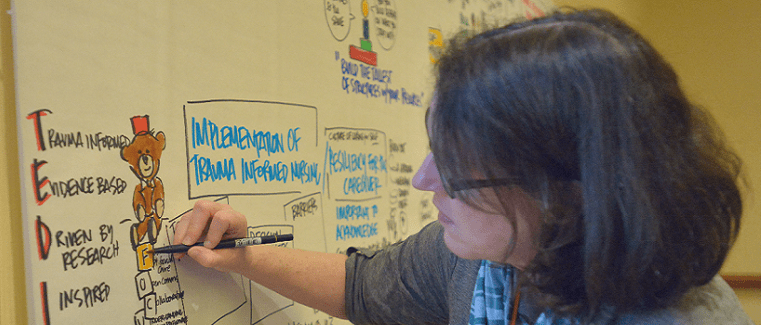
Stephanie hard at work coloring Patti Dobrowolski’s drawings December 5, 2019 From Stephanie Sundborg, PhD, Research and Evaluation Coordinator, Trauma Informed Oregon The Trauma Informed Care in Oregon Conference is over . . . It’s time to sit back, take a few breaths, and reflect on how it went, right? Implementation Updates Nov/Dec 2019

Training and Education Updates Sept/Oct 2019

September 26, 2019 From Ana Hristić, MA, LCSW, Training and Education Coordinator, Trauma Informed Oregon Many organizations begin their trauma informed care (TIC) journey with the training of their staff. Training can prepare the platform for content acquisition, as well as for reinforcement of values of an organization’s culture—in this Training and Education Updates Sept/Oct 2019

Implementation Updates Sept/Oct 2019

September 26, 2019 From Stephanie Sundborg, PhD, Research and Evaluation Coordinator, Trauma Informed Oregon “How might we measure that?” Believe me, I ask this question so often that I’m sounding like a broken record. But in fairness, this question is really at the heart of our attempt to find trauma Implementation Updates Sept/Oct 2019